
“Location matters, not timing”, or the opposite: “timing matters, because there are levels everywhere”. You hear both often.
The truth is in between. Location tells you where it’s worth acting. Timing tells you when. A good location with bad timing can still lose money, and perfect timing at a random location is just luck.
In this post we break timing into three parts: time of day, the moment of entry, and how long you stay in a trade.
1. Time of day: the market doesn’t trade evenly around the clock
Let’s start with data. Below is one full US500 session from Delta Analyzer®, from 00:00 to 24:00 Polish time (UTC+2).
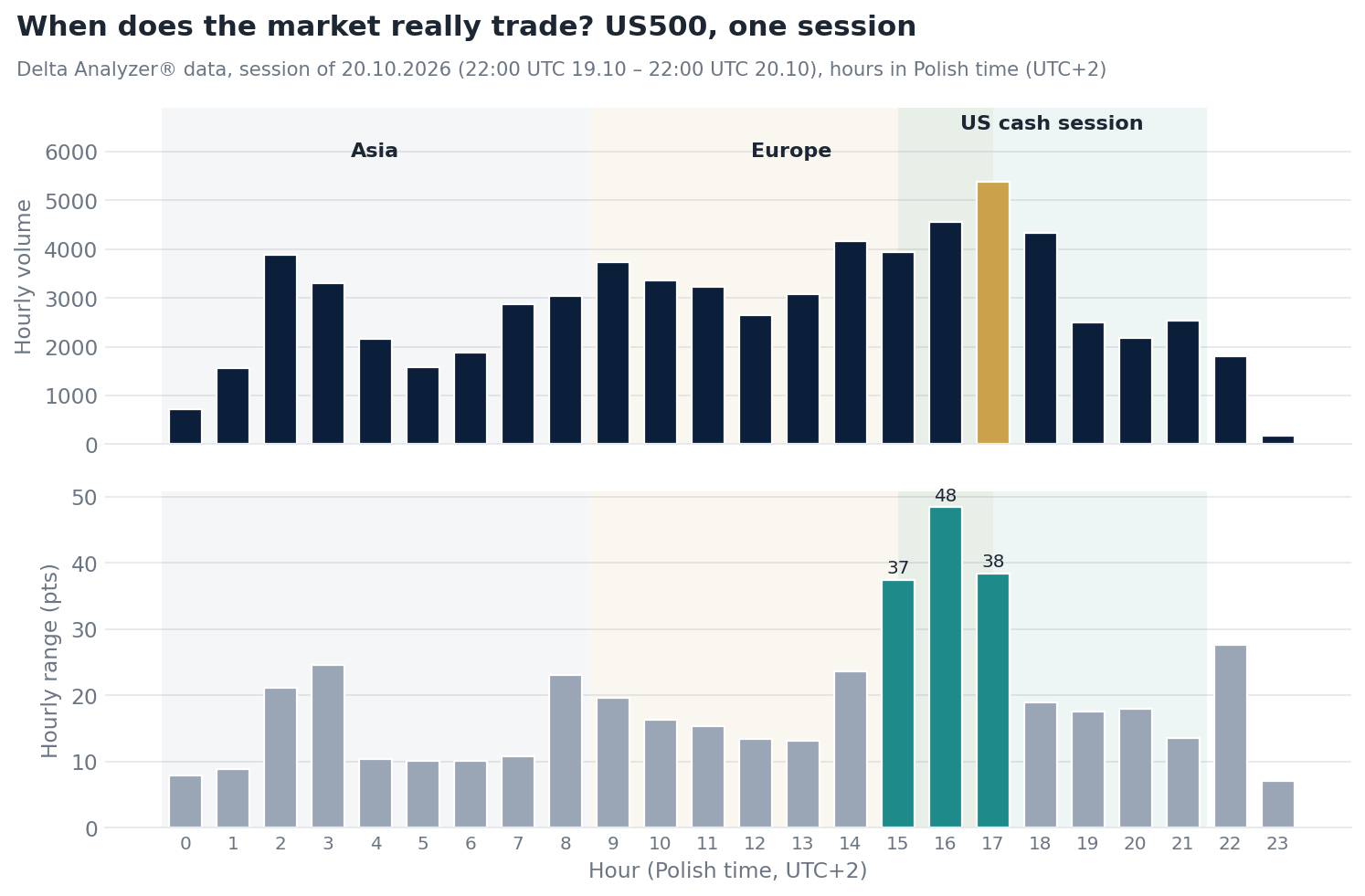
Delta Analyzer® data, US500, session of 20.10.2026. Hours in Polish time (UTC+2). This is one session, not an average of many days.
What do we see?
- At night and in the middle of the Asian session, the market sleeps. Between 04:00 and 07:00, the hourly range was about 10 points.
- The Asian open (around 02:00) and the European open (around 09:00) wake the market up. Volume and range roughly double.
- Most of the action comes after the US cash open at 15:30 Polish time (13:30 UTC). The 15:00, 16:00 and 17:00 hours had ranges of 37, 48 and 38 points. That’s 4–5 times the night-time range. The day’s highest volume came in the 17:00 hour.
- In the evening the market slows down again, with a brief pickup around the cash close at 22:00.
This is a single session, so the numbers will vary from day to day. But the shape of the day is very repeatable, and anyone can check it on their own instrument.
Watch out for the clock change. Europe switches to winter time on 25 October, the US a week later. During that week, the US cash session opens at 14:30 Polish time, then goes back to 15:30.
What this means in practice
The same setup behaves differently at different times. A range breakout at 04:00 often has no fuel, because nobody is trading. The same breakout at 15:45, at the US open, has volume behind it.
Your stop has to match the time of day. An 8-point stop works at night, but after the US open, one ordinary bar will take it out.
The hour before major data is a lottery. Before macro releases, the market often goes quiet, then makes a sharp move in either direction. Under our rules, we don’t open positions in the 30 minutes before major releases or in the last hour of the session.
2. The moment of entry: too early, just right, too late
Let’s say the location is good: strong support, for example the edge of the value area. There are still three ways to enter.
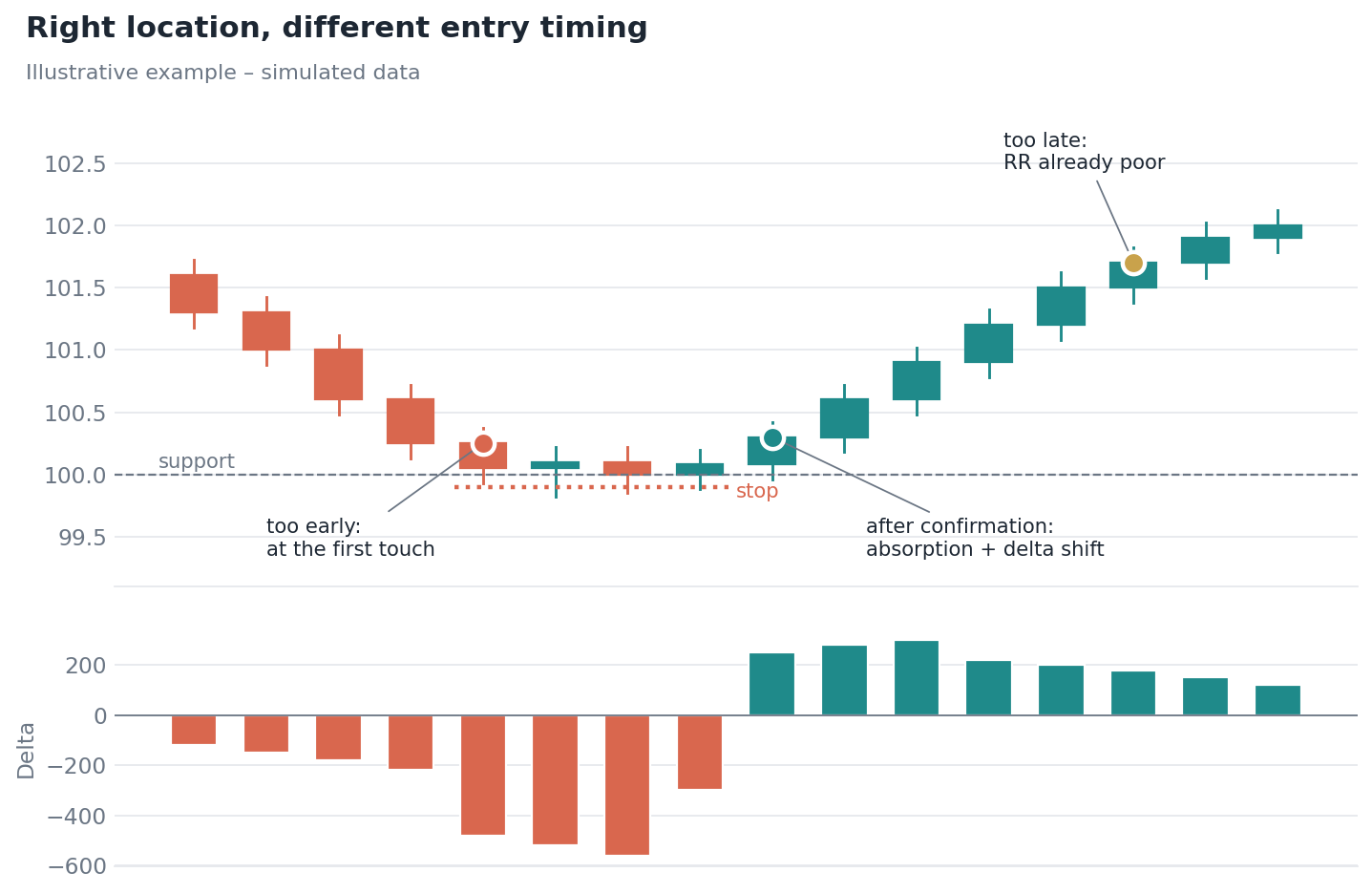
Illustrative example on simulated data.
Too early: at the first touch. Price is just reaching the level, and sellers are attacking at full strength. Delta is heavily negative. A tight stop below the level gets wicked out before the market turns. The level was good, and the trade still lost.
Just right: after confirmation. You wait for order flow to show a reaction: absorption, meaning heavy negative delta without price falling, followed by delta turning positive. The entry is a bit higher than at the first touch, but you have evidence that the level is working.
Too late: in the middle of the move. The move is already under way and you’re chasing it. The stop has to sit far away, below the level, while the target keeps getting closer. Reward-to-risk drops below a sensible minimum.
3. Time in the trade: every setup has an expiry date
Timing isn’t only about the entry. It’s also about the question: how long do you give the position?
Every setup has a logic that should play out within a certain time. A bounce off the edge of value should get going within a few hours. If price sits at the level all session and won’t move your way, something is wrong, even if your stop hasn’t been hit.
That’s why, under our rules, a position lives for a maximum of 8 hours or until the end of the session. If it hasn’t reached the target by then, we close it. No movement is information too.
What timing won’t fix
A bad location. A perfectly timed entry in the middle of a range is still an entry into the noise zone.
No plan. If you don’t know where your stop and target are, no timing will help.
Bad luck. Even a patiently timed entry can end in a loss. Timing improves the odds; it doesn’t guarantee them.
Summary
- Timing matters, but only after location. First where, then when.
- Time of day changes the market. In the 20.10 session, the hours after the US open had 4–5 times the range of the night. The same setup and the same stop behave differently then.
- Moment of entry: not at the first touch and not in the middle of the move, but after confirmation in order flow.
- Time in the trade: a setup that doesn’t work within the expected time is a signal to exit.
Have a question, or your own observations about time of day in your market? Write to tomek@ttechou.com or on X: @TomaszPacz42169.
Tomasz Paczóski
Content published on this blog is for educational purposes only and does not constitute investment advice. Trading derivatives carries a high risk of losing capital.